Learn piano through play
Klimperhelden is a learning game for children aged 6 to 12. Their own hero explains keys, notes and rhythm step by step, and with every right note their world gets a little colour back.
 Coming soon to the App Storefor iPad and iPhone
Worlds 1 and 2 are free. No ads, no account.
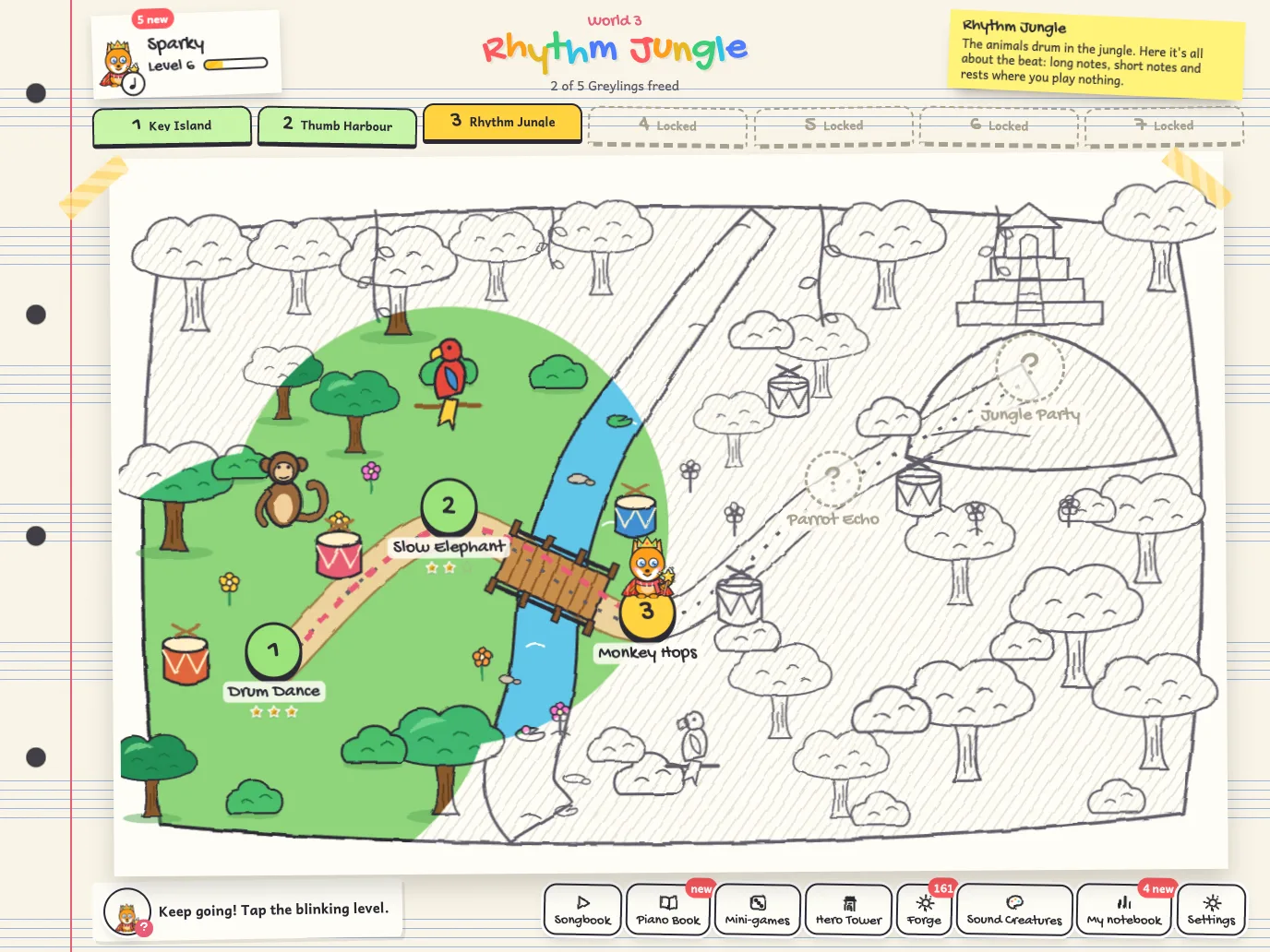
The Grey King has taken the world’s colours. Every right note brings them back.
Try it: tap a key!
Playing is learning
For children, play is not a pastime next to learning but one of the most effective ways they learn. Klimperhelden builds on findings from learning research.
Developed and tested together with children.
Guided play
Children learn particularly well when a game has a clear goal and they find the way there themselves. In a review of studies with children up to eight years old, this kind of guided play worked better than plain instruction for several skills.1
In Klimperhelden: Every level has a learning goal. The hero leads the way, the child does the playing.
Their own motivation
Children stick with something when they can make their own choices, notice that they are good at it and feel accompanied. Self-determination theory calls this autonomy, competence and relatedness.2
In Klimperhelden: Their own hero, learn or practice mode, bars or sheet music. Progress becomes visible, and the hero plays along.
Praise for the effort
In experiments, children who were praised for their effort rather than their ability kept going after mistakes and enjoyed the task more.3
In Klimperhelden: The hero says exactly what went well and only compares with the child’s own last attempt.
Mistakes are part of it
Children who are not afraid of mistakes try out more. Practice needs repetition, not pressure.
In Klimperhelden: Nobody loses. In learn mode the song waits, and Greylings are freed rather than beaten. Taking a few days off costs nothing.
- Skene, K., O’Farrelly, C. M., Byrne, E. M., Kirby, N., Stevens, E. C. & Ramchandani, P. G. (2022). Can guidance during play enhance children’s learning and development in educational contexts? A systematic review and meta-analysis. Child Development, 93(4), 1162–1180. doi.org/10.1111/cdev.13730
- Ryan, R. M. & Deci, E. L. (2000). Self-determination theory and the facilitation of intrinsic motivation, social development, and well-being. American Psychologist, 55(1), 68–78. doi.org/10.1037/0003-066X.55.1.68
- Mueller, C. M. & Dweck, C. S. (1998). Praise for intelligence can undermine children’s motivation and performance. Journal of Personality and Social Psychology, 75(1), 33–52. doi.org/10.1037/0022-3514.75.1.33
Understand first, then play
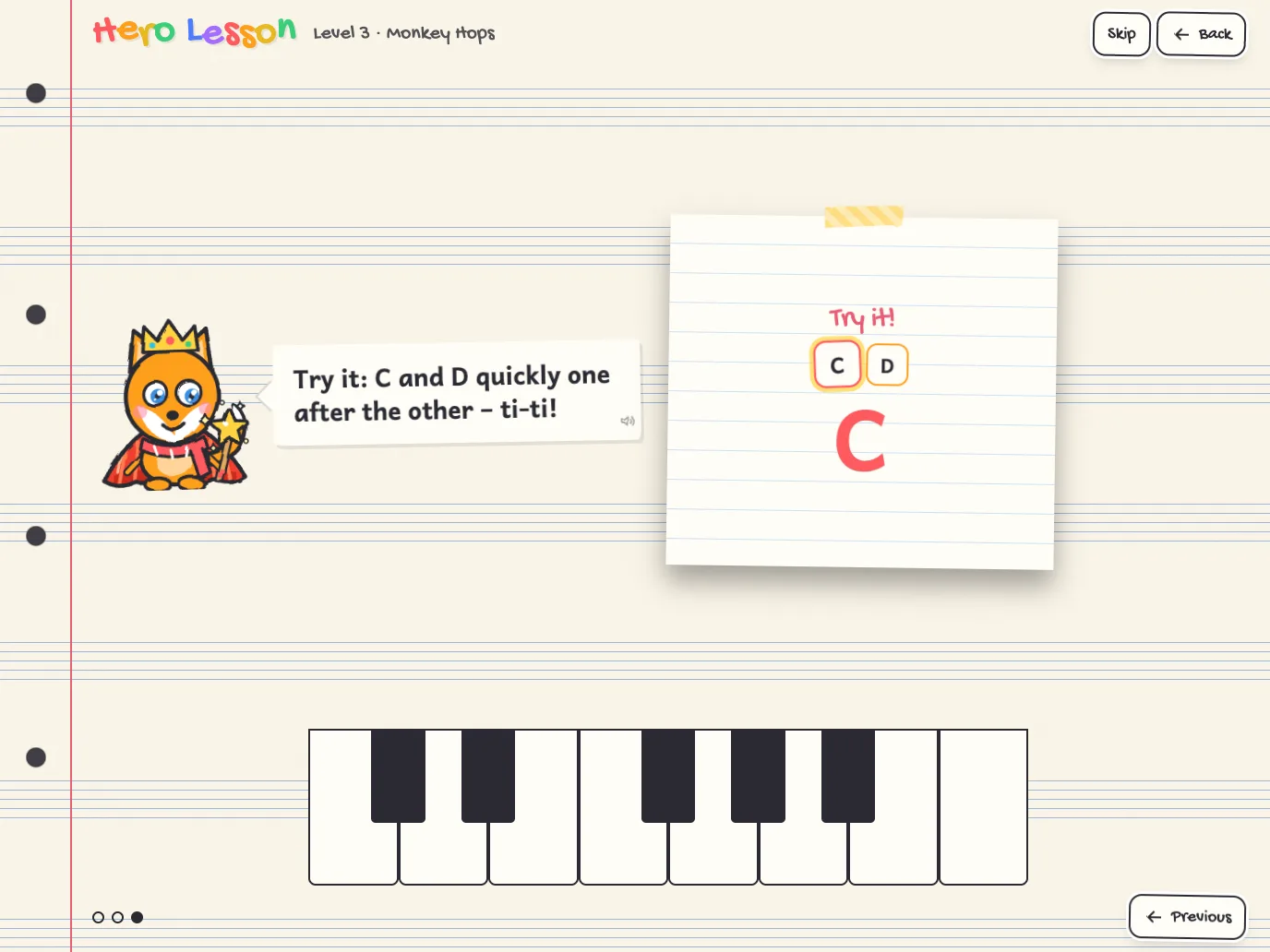
Every level starts with a hero lesson and ends with a song. Nobody loses: a wrong note just means trying again.
Bars or sheet music
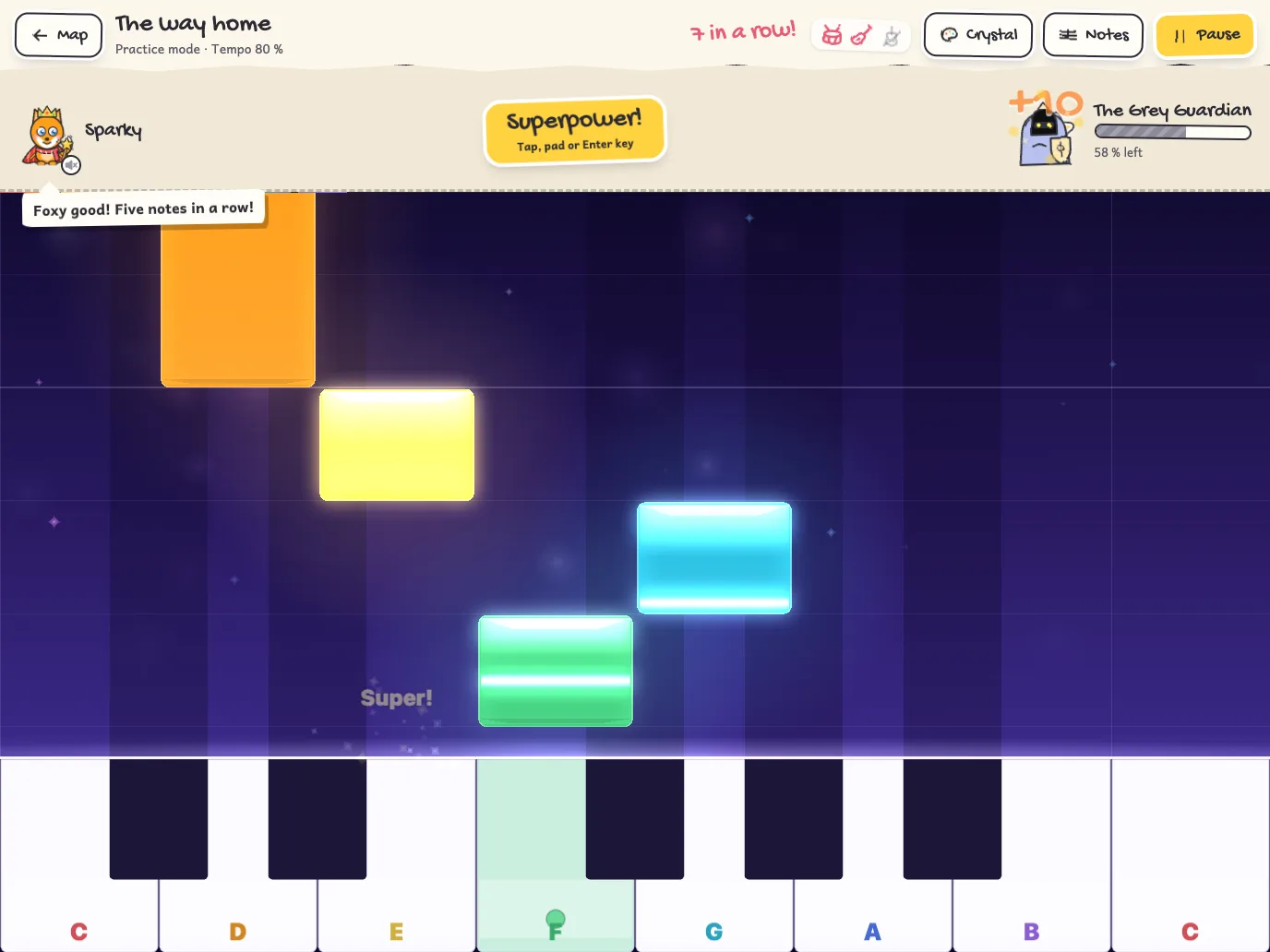
At first, coloured bars fall onto the keys, so you see at once which key comes next and how long it sounds. One tap on “Notes” shows the same song as sheet music, with treble and bass clef for pieces for both hands. You can switch at any time, even in the middle of a song, so reading music grows step by step.
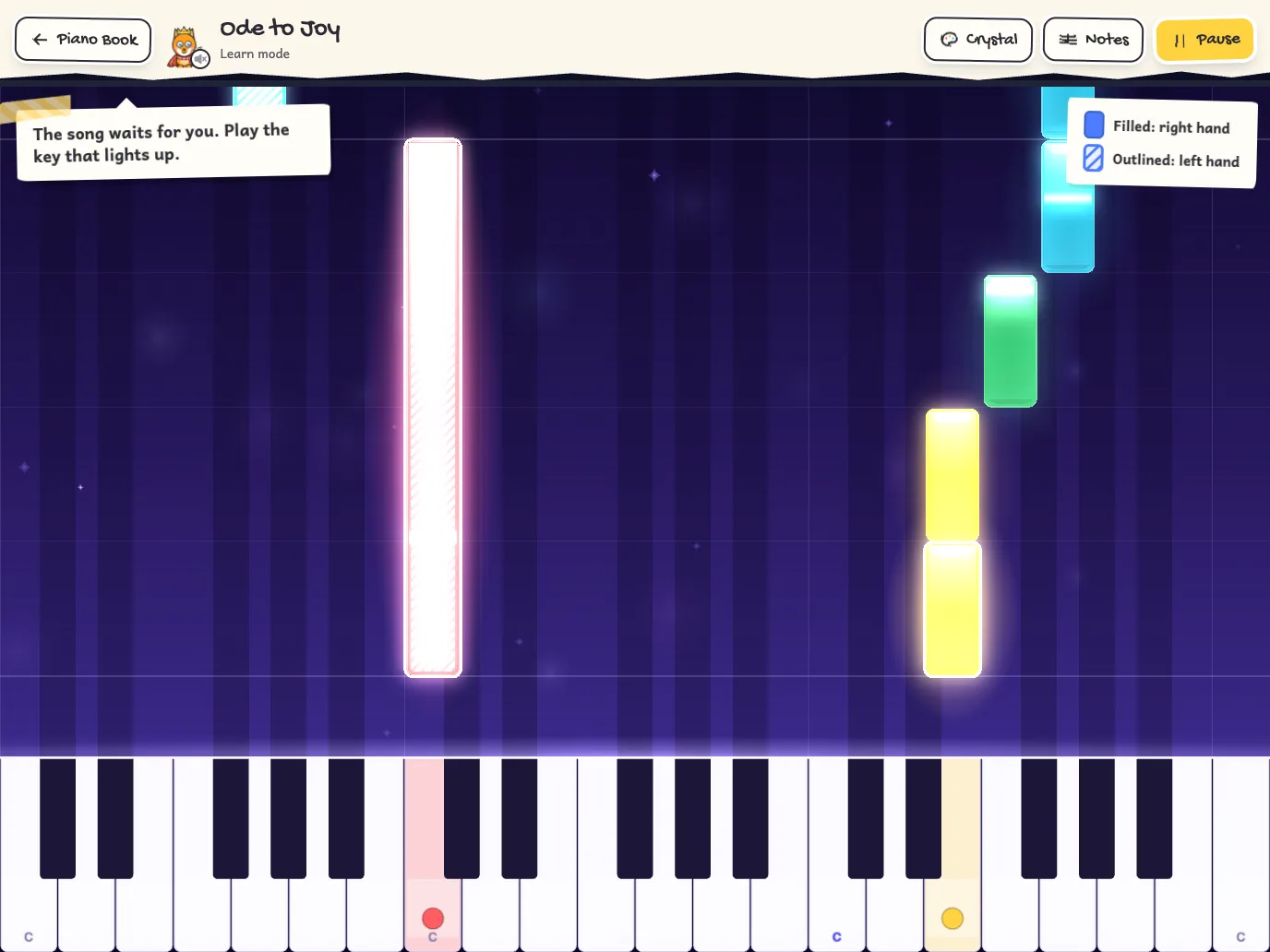
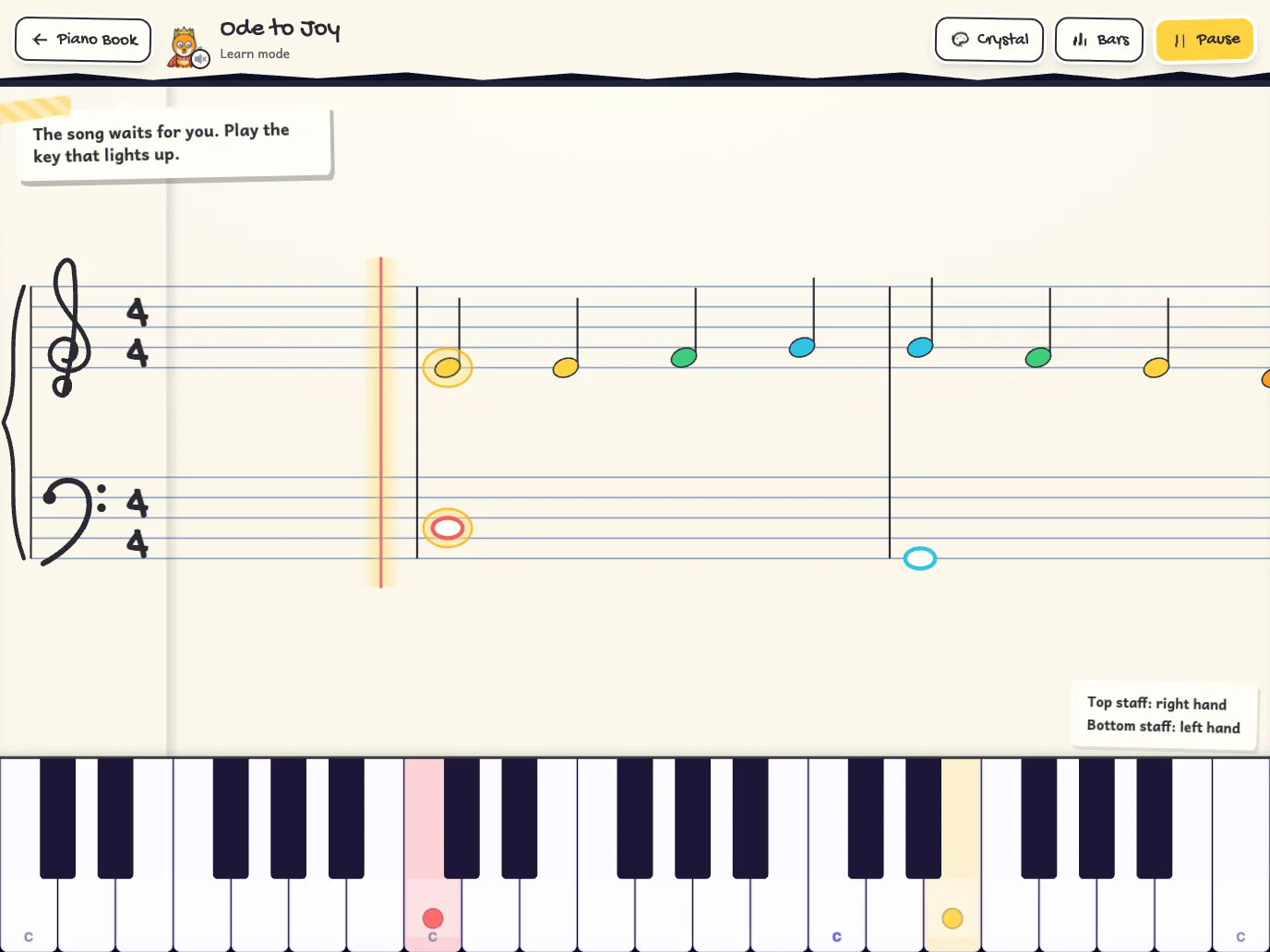
The sheet music view arrives with world 4; in the Piano Book it is there from the start.
Seven worlds, one learning path
The worlds build on each other like the chapters of a piano method. Each has five levels, with a boss waiting in the last one.
- World 1: Key Island freeFinding the keys C to G by the groups of black keys
- World 2: Thumb Harbour freeFive fingers in C position, first well-known songs
- World 3: Rhythm JungleHalf, whole and eighth notes and rests, in time
- World 4: Lighthouse of LinesReading notes in the treble clef
- World 5: Bass CaveThe left hand and the bass clef
- World 6: Bridge TownRight and left hand taking turns
- World 7: Storm CoastPlaying soft and loud: piano and forte
More than songs
There is plenty to do between levels, and almost all of it practises something along the way.
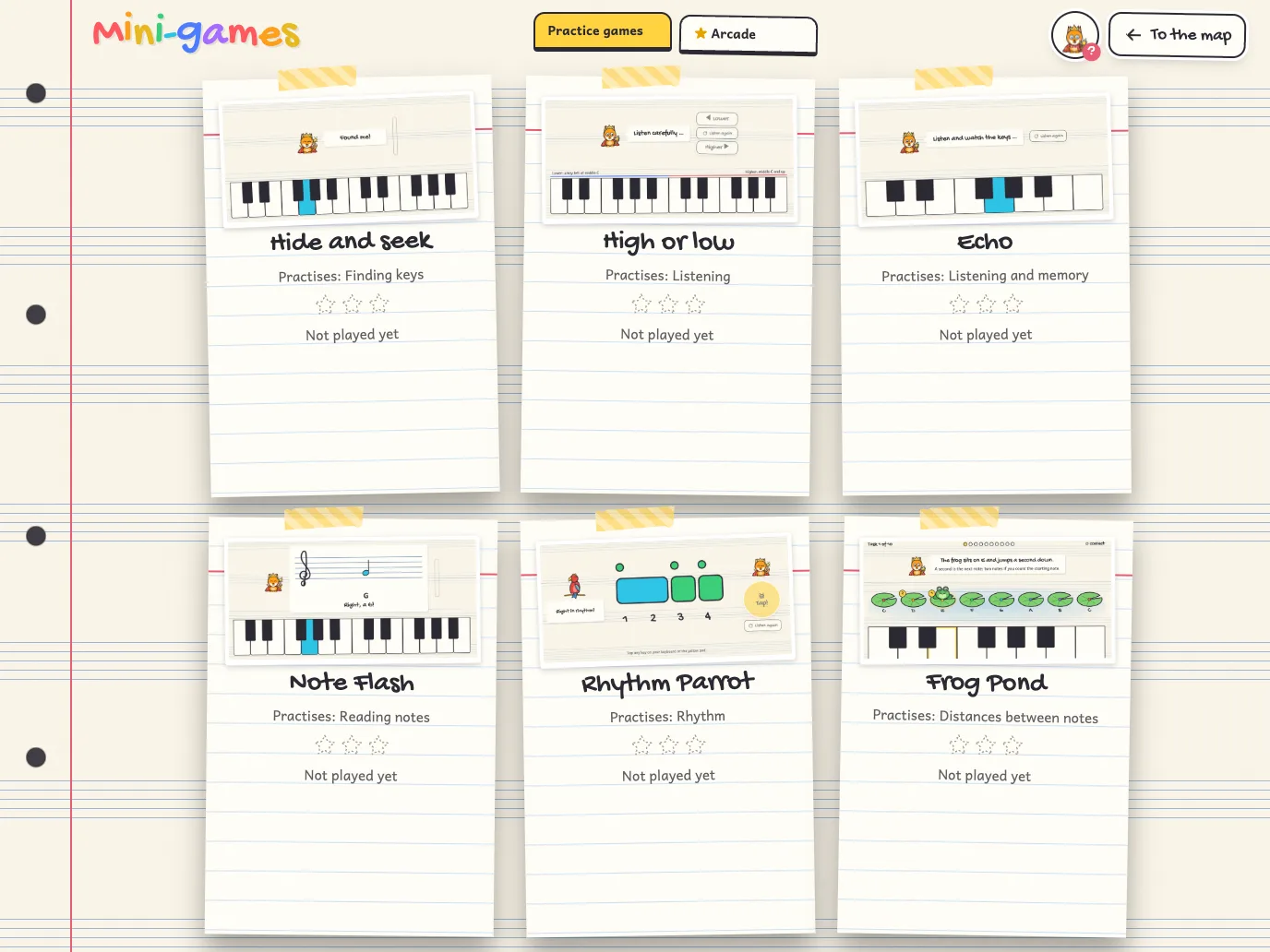
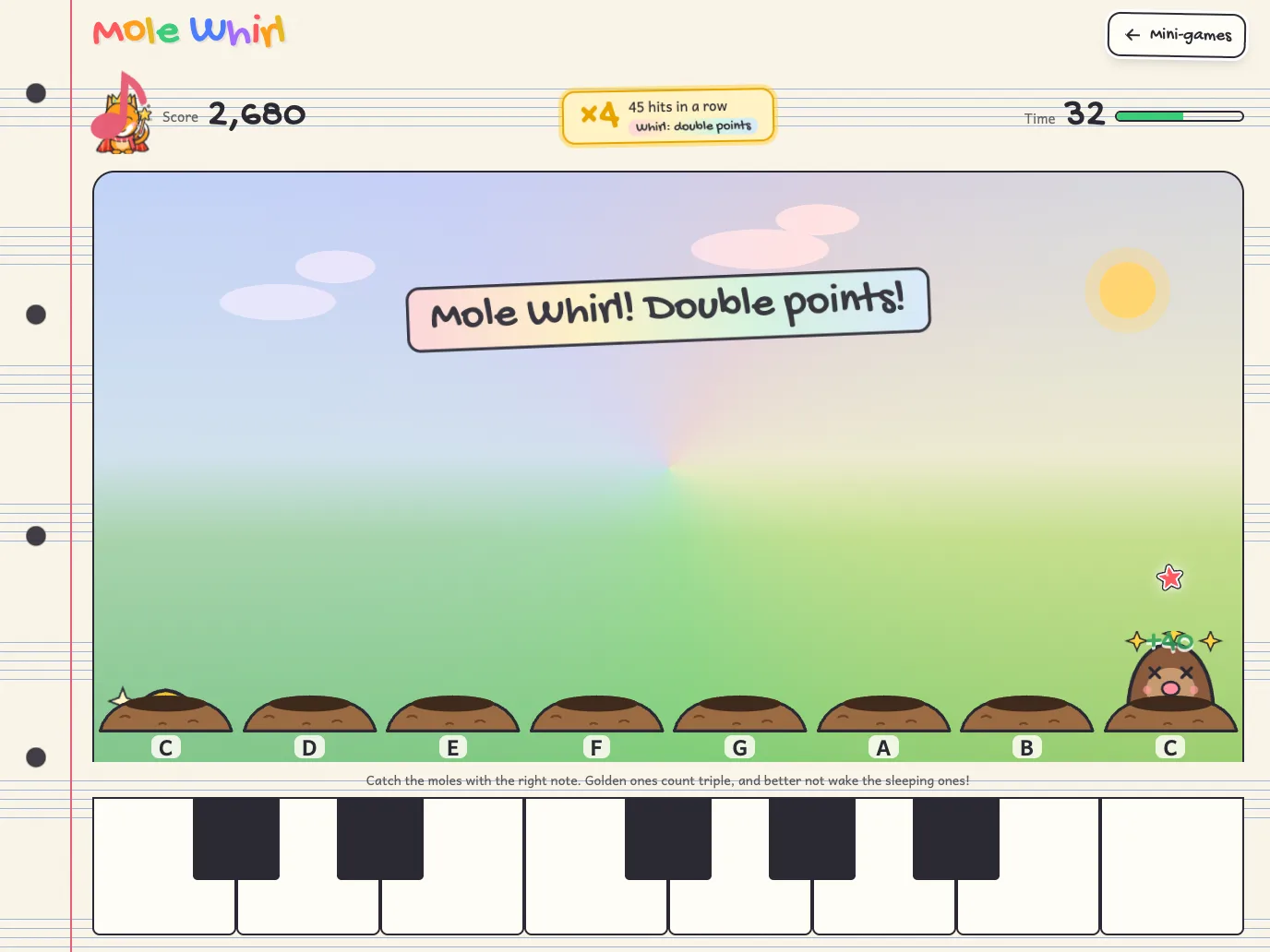
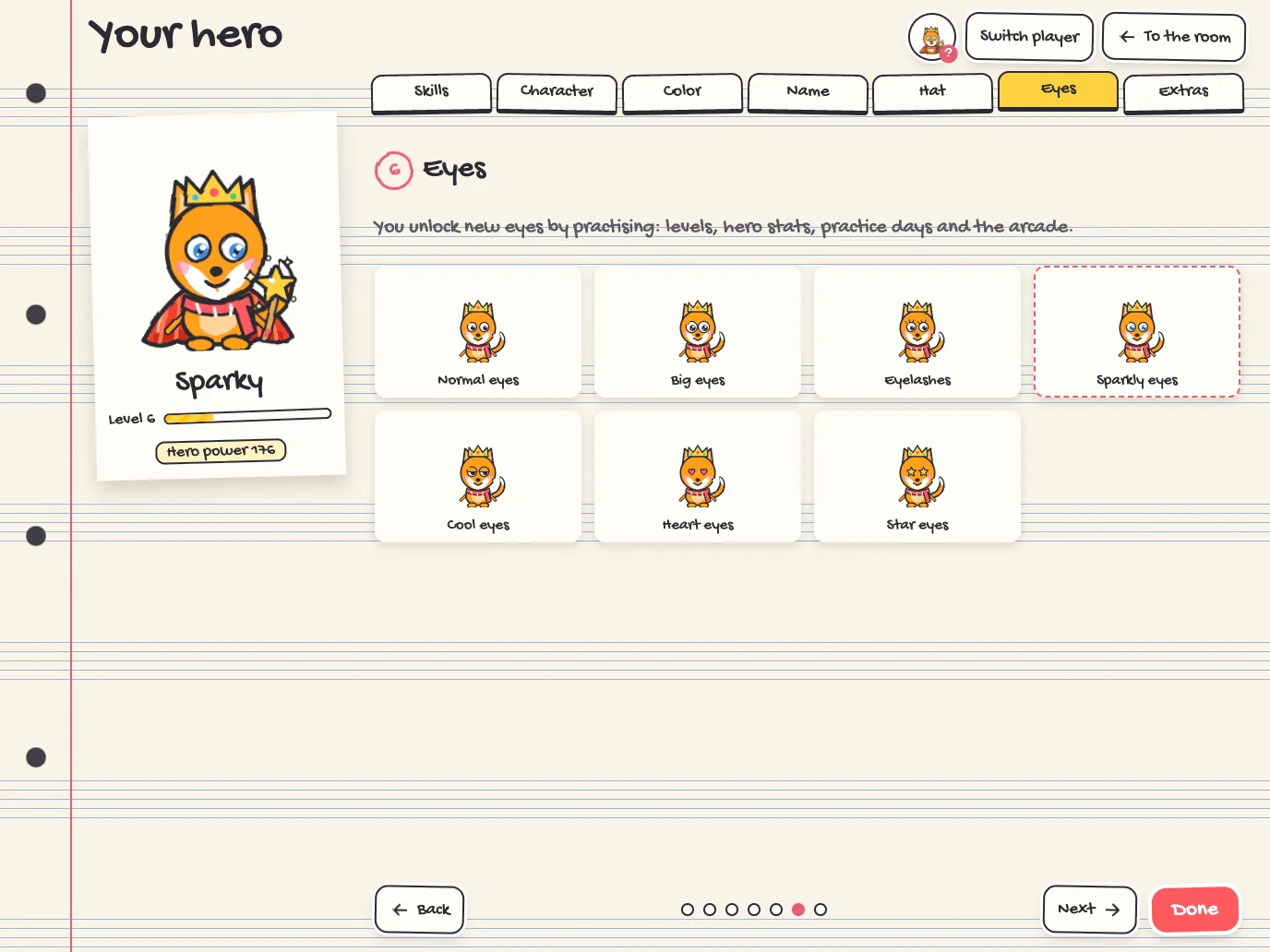
- Hero Tower
- Floor by floor, tasks on keys, notes, listening and rhythm. The more your child practises, the stronger their hero becomes.
- Songbook
- Children’s songs and classics to play freely, in full length.
- Piano Book
- Pieces for both hands with sheet music, for children who can already play.
- Song workshop
- Record your own songs, type in notes or load MIDI and MusicXML files.
- My notebook
- Practice time, daily tasks, badges and a garden that grows with every day of practice.
With a keyboard or without
Keyboard with a cable
Connect a MIDI keyboard or digital piano via USB, on iPad or iPhone with a USB-C or Lightning adapter. The game detects it automatically.
Keyboard without a cable
If the keyboard has no connection, the game listens through the microphone and recognises single notes. Everything is analysed on the device.
No keyboard at all
Large keys on the screen, matching the song. You can start right away.
For parents
Safe and calm
- No ads, no analytics, no account.
- Progress stays on the device, optionally backed up to your own iCloud.
- Up to five players on one device, each child with their own hero and notebook.
- Purchases only in the parents’ area behind a parental gate. The hero never pushes to buy.
Free and full version
Worlds 1 and 2 with all levels, four mini-games, the Hero Tower up to floor 10 and the Songbook are free.
The full version opens worlds 3 to 7, three more mini-games, the whole Hero Tower, the Piano Book and the song workshop. It is a one-time purchase with no subscription, for the whole family through Family Sharing.
In German and English.
Let’s play!
Pick a hero, connect a keyboard or simply tap the screen.
Coming soon to the App Storefor iPad and iPhone